


Michelle Obama’s New Book: A Rich Canvas of History and Politics 📚 👗
To wed the world of fashion with that of politics might seem an exercise in futility—a dalliance only fit for the pages of a glossy magazine. Yet, in her recently released book, Michelle Obama dares to traverse this curious terrain, presenting what could be best described as a historical document robed in the garb of a coffee-table tome. Her reflections beckon not just admirers of haute couture, but thinkers, revolutionaries, and anyone who plumbs the depths of cultural expression in the realm of governance. What if our understanding of history is so often constricted by the way we dress the part? 👔
Why should we care about the intricate details of a former First Lady’s wardrobe? Beyond the sequins and silk lies a striking antithesis: the contrast between the superficiality of appearance and the profound ramifications of representation. Each outfit—draped during critical public engagements—serves as a garment embroidered with invisible threads of societal change, interweaving signals of progress and resistance against a backdrop rich with political implications.
The Fabric of Influence
Consider, for instance, the historical moment when Obama, in a sleeveless gown, graced the stage of the Democratic National Convention in 2008. It was as if her attire whispered to the world: inclusivity matters, and it can be wrapped in elegance. In a time when the political landscape felt as unforgiving as a brisk winter evening, her sartorial choices painted a picture of warmth and approachability. Isn’t it just a touch ironic that in an era fraught with dissonance, something as superficial as fashion could wield such profound influence? 🤔
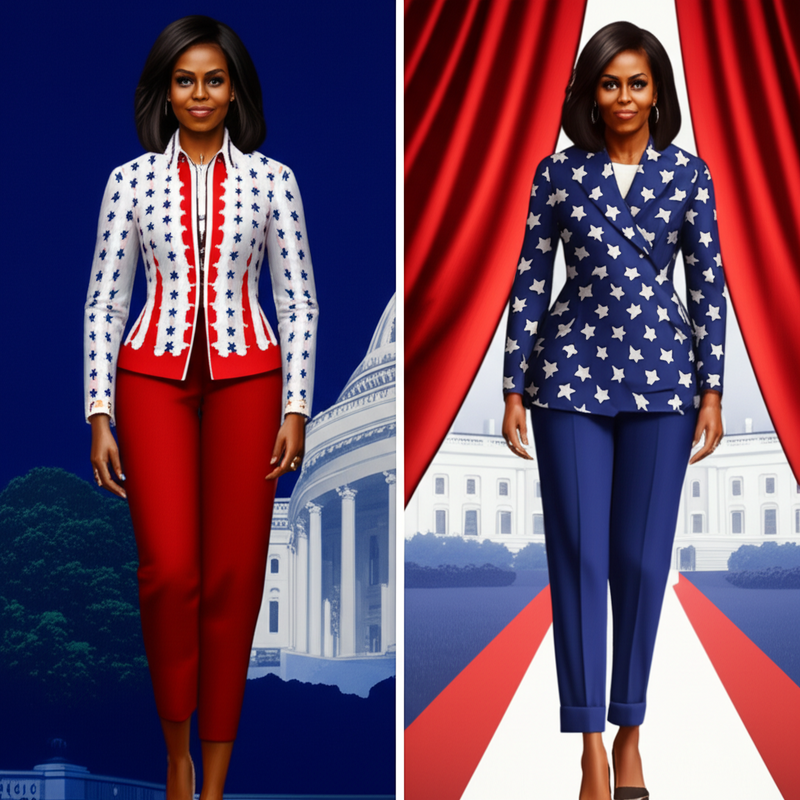
The images alone demand analysis. Was she merely following trends, or did every choice carry layered messages about gender, race, and identity? Looking back, it seems clear that every ensemble was a brushstroke on the canvas of political expression. The visual rhetoric of her choices—whether the stunning embroidery of a Jason Wu gown or the casual flare of a J.Crew cardigan—propelled conversations about what it means to be a woman in power. It becomes impossible to disentangle these threads from the broader narrative of her public service.
Revealing Insights Beyond the Fabric
More than mere fabric, these images serve as markers of resilience. In a body of work that strikes a profound contrast between personal vulnerability and public façade, Obama invites us to consider the implications of our appearances too. Are we not all, in some way, performers on the stage of societal expectations? Her book is a reminder that our everyday attire carries weight, often becoming emblematic of ideals bigger than their physical fabric 🧵.
Throughout her narrative, Obama employs evocative similes that challenge us to ponder the meanings hidden in plain view. Her exploration of style is not simply an aesthetic journey but one that examines the very bedrock of identity formation and self-presentation in a shifting cultural landscape. Each page is a reminder that clothing is not merely an external expression but a silent language that can either fortify or shatter barriers. In a sense, dressing can be transformative, akin to a chrysalis unveiling a butterfly. 🦋
Forward-Looking Reflections
As she reflects on her years in the White House, Michelle Obama’s insights become a tapestry woven with historical significance. Just as fashion has the power to elevate or obscure, so too does political discourse. Are her memories a call to action, urging us to reexamine our participation in this ongoing conversation about identity and representation? Or a gentle nudge, reminding us that the fabric of democracy itself hangs on the delicate balance of visibility and acknowledgment? 🌎
- Fashion as a Political Instrument: Can the visuals of a vibrant dress speak louder than verbiage at times?
- Representation Matters: How does the diversity of attire mirror the diversity of the people?
- Historical Context: What lessons can we derive from the past through the lens of sartorial choices?
Michelle Obama’s book is more than just a display of decadent outfits; it is a critical examination of how appearance, politics, and personal narrative intertwine. As future generations turn the pages, what will they glean about resilience in the face of systemic challenges? How will they interpret the subtle dances between dresses and debates? With her book, Obama hands us a series of mirrors—inviting us not merely to gaze, but to reflect deeply on our own roles within this intricate narrative. 🔍