



Supreme Court Will Weigh Gun Restrictions for Drug Users ⚖️🔫
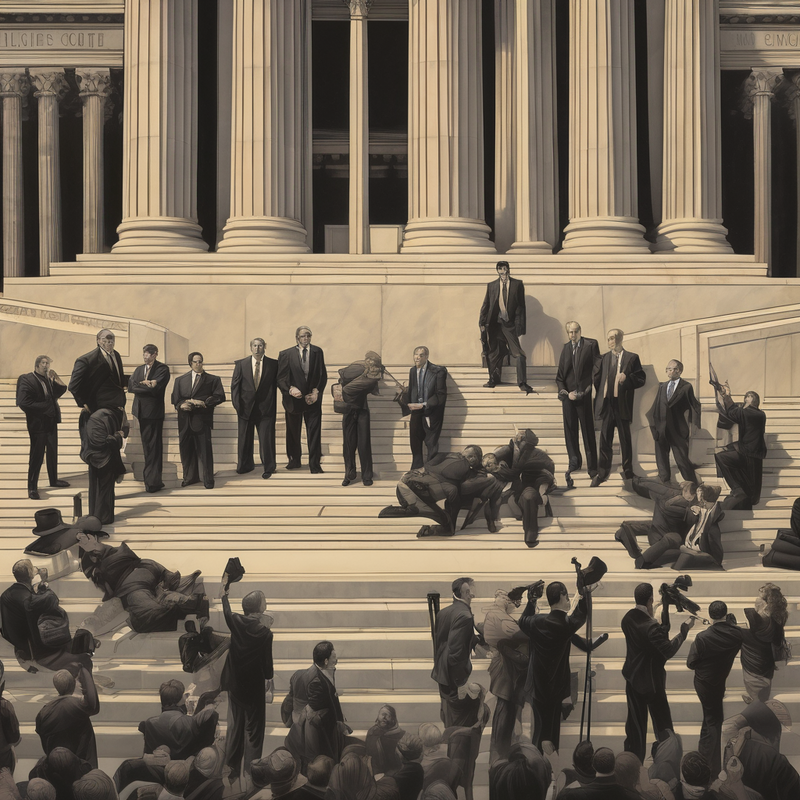
As the Supreme Court prepares to deliberate a case that stands at the intersection of drug policy and gun rights, one can’t help but marvel at the irony: in a nation that prides itself on its freedoms, certain groups may find themselves navigating a legal minefield that threatens to strangle their rights. This isn’t just about guns or drugs; it’s about a deeper question of societal value and the tangled web of public safety and individual rights.
A Tangled Legal Background
The focus of the case is stark and provocative. Should individuals who use drugs be prohibited from owning firearms? On the surface, it appears a straightforward inquiry into public safety. After all, what could be more threatening than a drug user brandishing a firearm? The reality, however, is a convolution of legal history and societal perceptions. The Second Amendment protects the right of the people to keep and bear arms, but like so many rights, it comes with caveats. 📜
The Supreme Court has previously ruled in landmark cases such as Heller and McDonald that the right to bear arms is individual and not contingent upon service in a militia. Yet, as recent as the Brady Handgun Violence Prevention Act, certain restrictions exist for individuals deemed dangerous, often based on mental health or substance abuse issues. Here, irony drips like a leaky faucet: the very laws intended to protect society may inadvertently strip rights from some of the most vulnerable members of it—namely, those battling addiction.
The Contrast of Perspectives
On one hand, proponents for stricter regulations argue that allowing drug users access to firearms is akin to giving a toddler a grenade. The presumption? That the chaos of addiction clouds judgment, rendering individuals incapable of making rational choices. But juxtaposed against this perspective lies a counter-narrative: that of rehabilitation and reintegration into society. Like a phoenix rising from the ashes, many individuals in recovery are fighting not only for their rights but for a chance at a second life—one in which they are not defined by their pasts 🔥.
One must ponder: is the answer to society’s fears found in further exclusion, or through the inclusion of individuals striving for recovery? Enshrined in American philosophy is the mantra of redemption, a stark contrast to a landscape riddled with stigma. This irony beckons us to question: can we truly protect the public while simultaneously championing the rights of those seeking to reclaim their lives?
The Human Element: Addiction and Rights
As the Court wrestles with these questions, they must remember that behind every statistic lies a person, struggling against an addiction as acute as the urge for freedom. The typical narrative surrounding gun ownership often entails rugged individualism, yet for many grappling with substance use disorders, individuality seems a distant dream. The law may treat them as mere statistics, yet their lives echo a critical truth: addiction does not erase humanity, and the struggle for rights is not just about guns or drugs, but about dignity.
Research reveals that individuals recovering from substance use disorders can demonstrate remarkably improved decision-making capabilities, especially when supported by community and ongoing treatment. By denying them firearm access, are we not simultaneously denying their potential for recovery? 🔍
Unpacking the Fallout: Public Safety vs. Individual Rights
The upcoming Supreme Court ruling will undoubtedly have ramifications, not just legally but also socially. It could set a precedent that ultimately acknowledges or perpetuates the stigma surrounding addiction. After all, regulating firearms for drug users may seem like a sensible compromise for public safety. Yet, it also raises a poignant question—do we want to live in a society where fear creates barriers that inhibit healing and reintegration? 🧠
This debate is not merely theoretical; it’s a flashpoint in the broader discussion of gun control and drug policy. As we scrutinize the implications of a ruling, we should reflect on what we hope to achieve: an empowered society where individuals overcome the constraints of their past, or one that propagates fear and exclusion. The juxtaposition of ideals here is as stark as night and day, and the decision looming on the horizon may inadvertently tip the scales.
Final Thoughts: Toward a Pragmatic Approach
As deliberations unfold in the hallowed halls of the Supreme Court, stakeholders from both sides will continue to position their arguments. Yet, perhaps a more nuanced approach is required, one that acknowledges the complexity of human behavior and the potential for recovery. Whether the Court takes a hard line or a more inclusive stance remains to be seen, but what is unmistakably clear is that the conversation needs to continue. We are at a crossroads where the choices we make today can reverberate through our communities for generations—a chance to pave a path towards understanding rather than division.
In the end, the Supreme Court must grapple not only with constitutional tenets but also the essence of what it means to be human—a delicate balancing act that is anything but straightforward. ⚖️❤️